
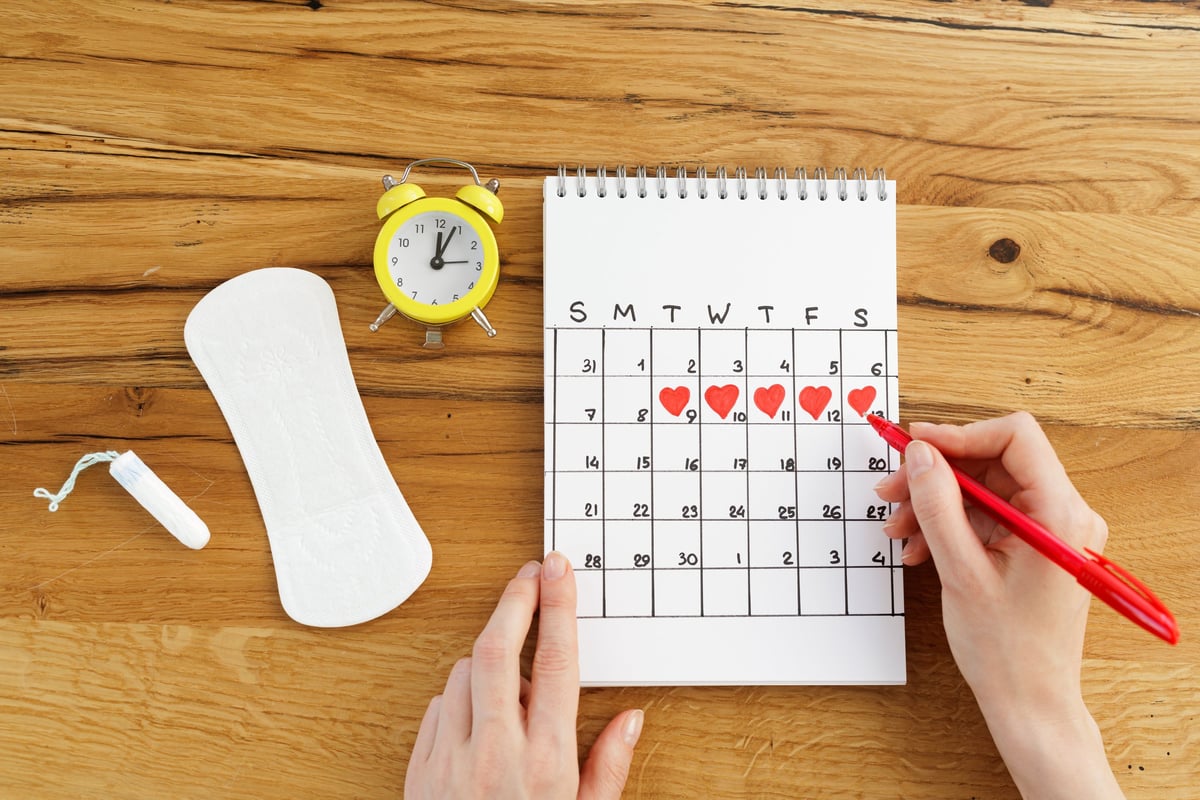
Many people grow up hearing that their period is just “how it is.” So they never ask whether their bleeding is actually normal. If heavy periods have been part of your life for years, it can be hard to know where normal ends and “too much” begins. Here's how doctors draw that line — and why it's worth finding out which side of it you're on.
How much period bleeding is normal?
Doctors look at three things: how often your period comes, how long it lasts, and how much you bleed.
- How often. A normal period starts every 24 to 38 days. Periods that start more often than every 24 days are called frequent. Periods that come more than 38 days apart are called infrequent.
- How regular. Cycles don't have to be exact, but they should be fairly steady. For most adults, cycle lengths that vary by more than about 7 to 9 days from month to month count as irregular bleeding.
- How long. Bleeding that regularly lasts more than 8 days is called prolonged. Prolonged periods often go hand in hand with heavy ones.
- How much. This is the tricky one. In research studies, “heavy” means losing more than 80 milliliters of blood per cycle — about a third of a cup. But no one measures that at home. So for everyday care, doctors use a simpler definition: bleeding is heavy if it gets in the way of your physical, social, emotional, or financial well-being.
One more note: bleeding between well-defined periods — called intermenstrual bleeding — is also considered abnormal and worth mentioning to a doctor.
What are the signs of heavy bleeding?
Since you can't measure milliliters, doctors ask practical questions instead. People with a normal amount of bleeding tend to go 3 hours or more between pad or tampon changes, use fewer than 21 pads or tampons per period, rarely need to change during the night, pass only small clots, and are not anemic.
Compare that with these signs of heavy bleeding:
- Changing your pad or tampon more often than every 3 hours on your heaviest days
- Using 21 or more pads or tampons in a single period
- Regularly waking up at night to change protection
- Passing blood clots about 1 inch across or larger
- Being told by a medical provider that you're anemic (low red blood cells)
- Bleeding that disrupts your plans, work, or peace of mind
Here's something important: research shows people often misjudge their own blood loss — in one study of over 200 patients who reported heavy periods, only about a third had blood loss above the 80-milliliter mark when it was measured. It cuts the other way, too. Some people have truly heavy bleeding that family, friends, or even health care providers have “normalized” for years. That's why these concrete signs matter more than anyone's opinion of what you should be able to handle.
What causes heavy periods?
Doctors organize the causes of abnormal uterine bleeding using a system called PALM-COEIN. It sounds technical, but the idea is simple: some causes are structural (physical changes in the uterus a doctor can see on imaging), and some are not.
Structural causes (PALM): Polyps — small growths on the lining of the uterus. Adenomyosis — a condition where the uterine lining tissue grows into the muscle wall, which can cause a tender, enlarged uterus and painful periods. Leiomyomas — the medical name for fibroids, noncancerous muscle growths in the uterus; fibroids that bulge into the inner cavity are the most likely to cause heavy bleeding. Malignancy and hyperplasia — cancer or overgrowth of the uterine lining, less common but the reason abnormal bleeding should not be ignored.
Non-structural causes (COEIN): Coagulopathy — bleeding disorders. Von Willebrand disease, an inherited bleeding disorder, affects about 1 percent of people overall but is much more common in those with chronic heavy periods. Clues include heavy periods since your very first period, heavy bleeding after childbirth or dental work, frequent nosebleeds or easy bruising, and a family history of bleeding problems. Ovulatory dysfunction — when ovulation is irregular or absent, bleeding often becomes unpredictable, with months of nothing followed by spotting or heavy episodes; most common in the years just after periods begin and in the years leading up to menopause. Endometrial causes — problems within the uterine lining itself. Iatrogenic causes — bleeding related to medical care, such as certain contraceptives (the copper IUD, for example, increases menstrual flow) or blood-thinning medication. Not otherwise classified — rarer causes that don't fit the other groups.
Pregnancy is also a common cause of unexpected bleeding, so doctors typically check a pregnancy test as part of any evaluation.
Can heavy periods make you anemic?
Yes. Losing too much blood month after month can drain your body's iron and lead to anemia — too few red blood cells. That's why doctors order a complete blood count for everyone with heavy menstrual bleeding. Many also check a ferritin level, which measures your iron stores. Ferritin matters because it can catch people who aren't anemic yet but whose iron is already running low. Both are simple blood tests.
When should I see a doctor about heavy bleeding?
Make an appointment if your periods match any of the signs above — frequent pad changes, 21 or more products per cycle, overnight changes, inch-wide clots — or if your cycles have become irregular, last more than 8 days, or include bleeding between periods. A single odd episode in an otherwise normal cycle may only need watching; keeping a record of your bleeding days can help your doctor see the pattern.
Some situations need urgent, in-person care. If you're bleeding very heavily and feel faint, dizzy when you stand, or notice a racing heart, go to the emergency department. And don't wait on symptoms just because you feel mostly okay — in young, healthy people, the body can compensate early on even when blood loss is significant.
Frequently asked questions
How many pads or tampons per day is normal?
There's no single daily number, but people with normal flow tend to go 3 or more hours between changes, use fewer than 21 pads or tampons over the whole period, and rarely need to change overnight. Needing changes more often than every 3 hours on peak days is a sign of heavy bleeding.
Is it normal to pass blood clots during your period?
Small clots can occur with normal periods. Clots about 1 inch across or larger, though, are a sign of heavy menstrual bleeding and are worth discussing with a doctor, especially alongside frequent pad changes or fatigue.
What is considered a heavy period?
For everyday care, a period is heavy when the bleeding interferes with your physical, social, emotional, or financial quality of life. In research settings, it's defined as more than 80 milliliters of blood loss per cycle. Practical signs — like soaking through protection every couple of hours — are how doctors judge it in real life.
Can heavy periods be a sign of something serious?
Often the cause is benign, like fibroids or polyps, but heavy or irregular bleeding can sometimes signal a bleeding disorder or, less commonly, overgrowth or cancer of the uterine lining. That's why new, worsening, or persistent heavy bleeding deserves a medical evaluation rather than a wait-and-see approach.
You don't have to guess what's “normal” about your bleeding.
We evaluate heavy and irregular bleeding by video visit — reviewing your bleeding pattern and history and ordering any labs you need, like a blood count and iron studies, which you can complete at a lab near you. If your story points to imaging or in-person care, we'll help you get there.
Book a Heavy Bleeding EvaluationMedical review & sources
This article is based on current clinical references on abnormal uterine bleeding in reproductive-age patients. It is for education only and is not medical advice or a substitute for care from your own clinician. If you are bleeding very heavily and feel faint, lightheaded when standing, or notice a rapid heartbeat, seek emergency care right away.
Medically reviewed by Margo Harrison, MD, MPH, FACOG · Last updated August 2026